



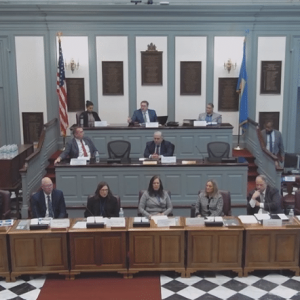
City Council’s Community Development & Urban Planning Committee clashed over whether to dissolve the Wilmington Land Bank and start over, or try to fix the current problems. (Photo credit: downtownwilmingtonde.com)
WILMINGTON — The future of the Wilmington Neighborhood Conservancy Land Bank came under intense scrutiny Monday night as members of City Council’s Community Development & Urban Planning Committee clashed over whether to dissolve the entity, and whether one of their own is being removed from the committee for demanding accountability.
The proposed ordinance, sponsored by Councilmember Shané Darby, would revoke the city’s authorization of the land bank, citing long-standing concerns about financial mismanagement, lack of transparency, and insider conflicts.
But the debate quickly veered into deeper controversy when Councilmember Coby Owens revealed he is being removed from the committee, and claimed it’s retaliation for his criticism of the land bank.
“This is probably going to be my last Community Development & Urban Planning meeting,” Owens said. “They went behind closed doors, had a meeting to remove me. They didn’t answer my questions with the land bank. They didn’t answer the questions on why they’re removing me from this committee.”
RELATED STORY: Residents protest after Council rejects rent stabilization in narrow vote

Owens has been among the land bank’s most vocal critics. He cited a 2024 performance audit from the city auditor that found failures across nearly every financial category, including delayed reports, unqualified staffing, and unvalidated reserves. The audit also noted the organization’s failure to complete timely financial documentation, including some records that were over a year late.
“They have misused funds,” Owens said. “And we have an official report from our city auditor that states that.”
Cabrera defends votes, sparking friction
Owens directly questioned Councilmember Maria Cabrera — who sits on the land bank board — about her continued support for the agency despite the audit findings. Cabrera confirmed she voted to approve city funding for the land bank, even after the concerns were raised.
“You voted to give them money knowing there were financial issues raised by our own city auditor, correct?” Owens asked.
“Yes, I did,” Cabrera responded, adding that the city had committed $1.5 million to the land bank when it was created, but only delivered the full amount last year.

Monday, June 23, Community Development & Urban Planning Committee meeting. (Coby Owens, Maria Cabrera, Shané Darby, Alexander Hackett, President Congo)
Cabrera defended the agency’s work in redeveloping vacant homes and stabilizing neighborhoods, especially on the city’s West Side and in Hilltop.
“There are homeowners who bought them at an affordable price and are living there — single moms, grandmoms with their children,” she said.
But the exchange intensified an already strained debate, as Darby, Owens, and Hackett pushed back on what they described as a broken system that benefits well-connected nonprofits while sidelining ordinary residents.
Accusations of favoritism and gentrification
Critics said the land bank has reserved properties for organizations whose leaders serve on the board, such as Habitat for Humanity, while declining to disclose who sits on its advisory board or why certain lots are designated “reserved.”
Owens, who represents Wilmington’s East Side, said homes transferred through the land bank in his district were selling for over $300,000 — far out of reach for most residents, whose average income is about $36,000.
“They’re not trying to get affordable housing for residents here in the city of Wilmington,” Owens said. “They’re trying to market this in the Philadelphia market to attract professionals.”
Several residents raised similar concerns during public comment, sharing experiences of being denied access to desirable homes or steered toward neglected properties in under-resourced neighborhoods. One mother described how her daughter tried for years to purchase land bank homes on Ninth Street, only to be directed elsewhere.
“They’re divvying out houses where they want you to live,” she said. “You’re not going to get those houses in areas where gentrification is happening.”
Land Bank accused of dodging Gibraltar oversight
Resident Maggie Messinger criticized the land bank’s handling of a Council resolution requiring a public hearing on the transfer of the historic Gibraltar mansion. Instead of a formal forum, she said, the land bank staged a neighborhood association presentation with glossy photos and no financial data, failing to address how over $3 million in taxpayer funds had been spent or how the mansion fit into the agency’s mission.
“The land bank is paying the bills, but no one knows what the plan is,” Messinger said. “Not one page in that shiny magazine had one piece of information about money.”
Council divided on a path forward
The ordinance calls for transferring land bank properties back to the city’s Department of Real Estate and Housing. Darby and Owens argue the move is necessary to rebuild a more transparent and equitable approach to housing development.
“They don’t deserve grace,” Owens said. “They haven’t done what they should be doing for our community.”
Councilmember Nathan Field and Councilmember Yolanda McCoy acknowledged oversight failures but said the city should focus on fixing the land bank rather than eliminating it.
“Fix it rather than end it,” Field said. McCoy added, “We dropped the ball-but we’re in a different term now. Let’s fix it.”
The legislation has not yet advanced to a vote. If passed, it would mark a dramatic shift in Wilmington’s housing strategy — and signal a rebuke of how the city has managed public land, redevelopment, and accountability.
RELATED STORIES:
![Redding Consortium members meeting around a U-shaped table.]()
Redding Consortium Recommends Single Northern New Castle County School District
12/17/2025![Holiday Model Railroad Return to Brandywine Museum of Art, Blending Art, Tradition and Family Magic]()
Holiday Model Railroad Return to Brandywine Museum of Art, Blending Art, Tradition and Family Magic
12/17/2025![Echoes Brings Pink Floyd’s Legendary Sound to The Queen Theatre This Weekend]()
Echoes Brings Pink Floyd’s Legendary Sound to The Queen Theatre This Weekend
12/16/2025![Bardea Blend Brings Wilmington’s Creatives Together on December 18]()
Bardea Blend Brings Wilmington’s Creatives Together on December 18
12/16/2025![Kirily of Make & Mellow Named Downtown Wilmington’s December Customer Service Champion]()
Kirily of Make & Mellow Named Downtown Wilmington’s December Customer Service Champion
12/16/2025![Delaware Lawmakers, School Officials Tackle Property Reassessment and School Funding Reform]()
Delaware Lawmakers, School Officials Tackle Property Reassessment and School Funding Reform
12/15/2025![A Last-Minute Gift Shopper’s Dream: Brandywine Holiday Festival of the Arts Returns]()
A Last-Minute Gift Shopper’s Dream: Brandywine Holiday Festival of the Arts Returns
12/15/2025![A Quieter Holiday Moment Awaits at Rockwood Park & Museum]()
A Quieter Holiday Moment Awaits at Rockwood Park & Museum
12/15/2025




Claudia is a Philadelphia-based journalist and reporter passionate about storytelling that informs and engages the community. Claudia, a proud Temple University graduate, has built a career covering impactful stories and creating compelling content across digital and print media platforms. With a strong background in writing, editing, and research, Claudia has worked on various topics, from local news to in-depth features, always striving to deliver meaningful and accurate reporting.
Share this Post